
Architectural Steel Handrails in Seattle & the Puget Sound
Finish Selection, Environment & Material Integration in High-End Residential Design
In custom homes across Seattle, Bellevue, Kirkland, and Bainbridge Island, wall-mounted steel handrails are often perceived as simple architectural details.
Their success, however, is determined less by form and more by finish.
In the Puget Sound region, environmental exposure, surrounding materials, and long-term durability must inform finish selection from the beginning of the design process.
Finish Is Not an Afterthought
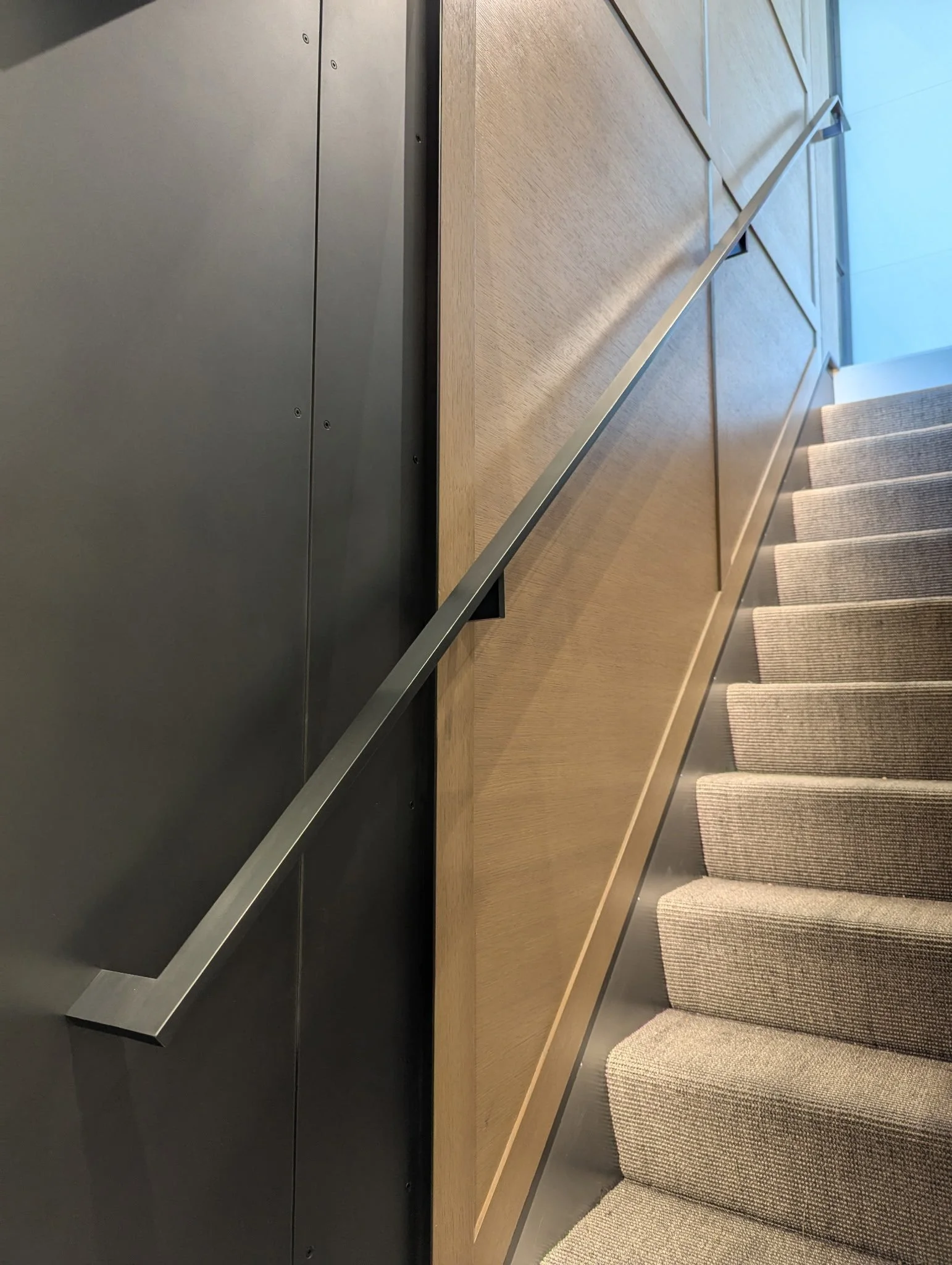
Lake Washington Wine Room Blackened Steel Handrail
Architectural steel handrail with coordinated finish and concealed structural backing. Material selection and sheen were calibrated to integrate with surrounding wood paneling in a Puget Sound custom home.
A steel handrail interacts constantly with:
Human touch
Ambient humidity
Adjacent wood or millwork
Glazing and natural light
Cleaning products and maintenance routines
The finish must respond to all of it.
A brushed stainless rail in a Bellevue hillside home may complement white oak and concrete beautifully. In a marine-adjacent property on Bainbridge Island or Queen Anne overlooking Elliott Bay, the same material may require upgraded specification or protective strategies to maintain its clarity.
Finish decisions are environmental decisions.
Environmental Considerations in the Puget Sound
The Seattle metropolitan area presents microclimates that materially affect metal performance.
Inland Eastside properties typically experience lower salt exposure than coastal or elevated waterfront neighborhoods. Homes on Bainbridge Island or in marine-influenced Seattle locations may encounter greater moisture and airborne salt.
These variables influence:
Stainless steel grade selection
Protective clear coats
Powder coat system rating
Brass alloy choice
Maintenance planning
Over-specifying in low-exposure environments unnecessarily increases cost. Under-specifying in marine conditions accelerates corrosion.
Finish calibration is essential.
Interaction With Surrounding Materials
A handrail does not exist in isolation.
It sits against:
Veneered millwork panels
Painted gypsum assemblies
Hardwood treads
Stone or concrete surfaces
Finish texture and sheen must align with the broader material palette.
For example:
A matte blackened steel finish can reinforce a restrained Pacific Northwest aesthetic.
A brushed stainless finish may echo window framing or hardware selections.
Powder coat systems must be selected with awareness of sheen level to avoid visual discord with adjacent surfaces.
Even subtle differences in gloss can disrupt a disciplined interior.
Architectural metal should integrate, not dominate.
Durability & Touch Performance
Unlike many architectural components, handrails experience constant physical contact.
Finish systems must account for:
Skin oils
Abrasion
Cleaning cycles
Long-term patina development
In Seattle-area custom homes where material honesty is valued, controlled aging may be desirable. In other environments, maintaining a consistent finish appearance is critical.
Understanding how a finish will evolve in the Puget Sound climate allows architects and builders to make informed decisions.
Precision Before Finish
Finish quality also depends on fabrication discipline.
Surface preparation, weld refinement, and edge detailing determine how coatings adhere and how brushed finishes present under light.
Natural light in Seattle homes, especially those with expansive glazing overlooking Lake Washington or Puget Sound, reveals surface inconsistency immediately.
Proper preparation precedes proper finish.
Studio Metaline: Architectural Handrail Fabrication in Seattle & Beyond
Studio Metaline works with architects, designers, and builders throughout Seattle, Bellevue, Kirkland, Bainbridge Island, and the greater Puget Sound region to design and fabricate custom architectural metal elements.
Our process evaluates:
Environmental exposure
Surrounding material palette
Desired aging characteristics
Structural integration
Finish sequencing
Architectural metal performs best when finish, fabrication, and environment are considered together.
In high-end residential construction, that integration defines longevity and visual clarity.